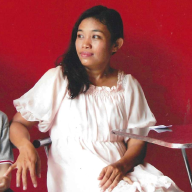
I have been teaching this child since she was in late kindergarten, and she is now in 3rd grade of elementary school. She comes from a low-income family. Her mother works at a small company, runs a laundry business, and sells gado-gado in the evenings. Her father is also an employee at a small company. There is no one in the family who speaks English. So she learns to communicate in English in my class, once a week, for only one hour per session.
At our first meeting, I came and invited her to play, but I spoke 100% in English. I acted as though I were a parent enjoying time together through the English language. I created bonding, a beautiful connection, a relationship, and a gentle trust that made her feel comfortable. At first, she loved baking. We made donuts together, making dough she could eat. I only brought flour and a few basic kitchen ingredients, whatever was available. And every time I visited, I brought her something she liked, always very inexpensive.
For this particular student, I had an instinct that she would become one of my special pupils. My tutoring fee for her is the most affordable rate for a private home tutor, Rp 150,000 for 4 sessions. She sometimes tells me about her mother ironing many clothes just so she can afford the lessons.
After the donuts and bread dough, we moved on to painting. It turned out she had a gift for it. I brought her my child’s old painting supplies that were no longer being used. She created paintings that now hang and decorate her room, all while we discussed and spoke in English. At the end of each lesson, we would enjoy YouTube together, watching short movies she liked that were connected to our lesson topics.
After painting, she asked me to bring craft supplies. She made many crafts, and when finished, she would give them to me. Those crafts now decorate my bedroom. There is a deep bond between the two of us.
Our English conversations were simple at first. She would whisper questions in Indonesian into my ear. I believe she also watched English-language content on the internet on her own. I showed her through tangible experience that learning English is enjoyable and not difficult. Without confrontation, applicative concepts quietly entered her inner self, infusing her spirit and her ability to speak, as well as her vocabulary. More and more words began to emerge from her little mouth. Her mother gave us plenty of space to interact, placing full trust in me and in my genuine intentions.
I begin each lesson with a soft, relaxed voice. My eyes are gentle as I watch Faza, showing warmth toward the child. The affection between teacher and student is beautiful, and we spend our time together with many things she can reach and understand.
Since she started elementary school, I began giving her increasingly intensive exercises, reading from Google at her level, games, vocabulary from the Wordwall portal, and dictation (which she dislikes, because if she makes mistakes her mother scolds her quite harshly, so we only do it occasionally). Grammar is an area where she is somewhat weaker, perhaps because she is not yet fully accustomed to it and is still adapting to the grammar system.
And now, she has become a person who possesses English language ability far above the standard level for Indonesian children learning English. I often give her upper-level exercises, ones she is capable of doing. Her level is indeed two levels above the standard.
Here, English has been absorbed into the soul of that child. English has merged into her heart and mind. I call this ambient language. I will continue teaching her for as long as possible, for a very long time, even at my senior age. I know and I am aware: I am helping her and her family break free from the grip of poverty and hardship.
Let us focus on ambient language. In the theory, through gentle, non-confrontational teaching, English is loaded into the student’s brain, not as a theoretical subject, but as an application that creates memory and comfort. The child uses English as a unified whole, between heart, soul, mind, and behavior. There is a rhythm within her and her thinking, supported by the movement of her mouth, eyes, hands, and natural gestures, not from Indonesian, but from English. Yes, it has become one with the soul of that child. I hope this participant observation is useful in English language teaching, especially for children. They are in their golden phase for language learning. Let them enjoy English as a beautiful, rhythmic language. Let them dance and sing within that rhythm, so that a beautiful song may be created from their little mouths.
Warm regards, Miss Puji